From NewConsumer.com, "UK's Hottest Ethical Lifestyle Magazine" [their words, not mine], comes an Uber Wind Turbine located in Swaffham, Norfolk. The Wind Turbine stands some 219 Feet [67 meters] tall and boasts an observation deck that is open for public access /viewing. According to Ecotricity (the turbines' operating electric company), the Turbine can power about 1000-1500 houses.
Visitors can climb the 300 steps inside the Turbine's structure to get a view of the town and see the MASSIVE 3-ton, 30 meter long Blade span up close. (30 meters ?? Holy Cow!) The Turbine was made in Germany in 1999. Ecotricity has plans to roll out at least 6 more Turbines throughout the UK. Get a load of the hum made by 9 tons of blades spinning by !
You'll need Flip4MVW or Flash to view the movie, or go to
Green.tv who also has posted clips (in various video formats) of this report.
Home owners should note, space allowing, smaller scaled Wind Turbines can be utilized to help power a single family home. Wind Turbines are a good alternative power source (when solar panels are not feasible.) I'll have more info on Wind Power in coming posts-- including info on a Chicago based Wind Turbine company that is making headlines with their innovative technology.
Post your thoughts -- Shanty Minister
Tuesday, September 25, 2007


Sunday, August 19, 2007
Designing A Green Thumb

Landscaping and the design of outdoor spaces is just as important as designing structures and their interiors.. So, it's always a challenge finding simple solutions to introduce a bit of greenery into busy urban lives. Who doesn't enjoy a lovely garden? Well, these two products are a long way from being the perfect garden, but they provide a good start for the [good] design conscious among us.
From the UK, the self-watering WET_POT for plants (for those who travel a lot or otherwise kill their plants by watering them too much or too little.) The manufacturer says the special glaze on the outside of the pot allows --through capillary action-- the water in the surrounding reservoir to slowly be used by the plant as needed.. Kinda like nature, I suppose... (Altho' I can see that clear reservoir getting cloudy and yucky if you don't wipe out the water stains regularly..) Pots come in 3 sizes and I think they'll ship to North America. It's cool looking just the same...
.............................................................
 And from RephormHaus (Germany), the Steckling Balcony Flower Pot. it straddles the railing for all you urbanites who need a little green on your balcony. The "Steckling" comes in 3 colors and they even have a Trellis prototype that makes for vertical climbing greenery. At least the pots won't be swept off the balcony by a gust of wind. Sweeeet!
Thursday, May 03, 2007
Designed to Love
 Sometimes the great abundance of bad design and poor taste can give fans of [good] design the blues. With the pedestrian lakefront housing designs proposed for the Chicago 2016 Olympics, it's easy make the case that poor taste will never go out of style. Then one day, you flip a magazine page and stumble on a beauty -- relieved that some structure or item other than the local Starbucks is NOT the best designed thing in your city or neighborhood. (OK, that might be overstating things, but the beauty of blogging is being bombastic.)
So, from the "Designs I Love" files, I'll be introducing (or jumping on the bandwagon) in presenting some items for creative consideration.
Let's start with the Pedro and Ines Footbridge (November 2006, Rio Mondego) in Coimbra, Portugal. A collaborative design by Cecil Balmond and Antonio Adao da Fonseca. (Thanks to Hugo for the pics.. Check out his site at Flicker.)


Sunday, March 04, 2007
VM Housing - Orestad, Denmark

I was surfing e-architect.co.uk, , and came along this project near Copenhagen. At first glance, the project looks almost hostile-- like steel and glass shards ready to cut passerbys. (That's probably my urban/public housing background bias talking..) After a more careful investigation, the layout shares little with the large American multi-family layouts from the 1950s. Considerably more attention is given to light, air, views (from the units), unit privacy, and even some personal outdoor space (via balconies) for some of the luckier inhabitants.

VM Housing (Orestad City, 2006) was a collaborative design by PLOT Architects (no longer in business). It's got interesting massing and interior layouts, an exterior that channels abstracted Rietveld, and the requisite modernist glass and steel curtainwall vocabulary. This project is part of a larger master planned multi-use development underway in Orestad over the next 17 or so years.
A brief description from the architects' website:
"The manipulated perimeter block is clearly defined in its four corners but opened intrenally and along the sides. The vis-a-vis with the neighbour is eliminated by pushing the slab in its center, ensuring diagonal views to the vast open fields around...All apartments have a double height space to the north, and wide panoramic views to the south. The logic of the diagonal slab utilized in the V house is broken down in smaller portions for the M house. In this project the typology of the unite d'habitation of Le Corbusier is reinterpreted and improved: the central corridors are short and get light from both ends, like bullet holes penetrating through the building."

 PLOT Architects is now divided into two different firms: JDS Architects and BIG (Bjarke Ingels Group)--both of whom have more info and photos on the VM project on their respective websites. A quick Google search yields some photos from the forum group "Skyscraper City - The Big Huge Copenhagen Orestad Thread Part 2", showing the complex under construction. Check those photos out as well.
Looks to be partially pre-fab, huh? Can anyone tell me if this is rental or affordable housing? And what is the cost per unit (monthly in comparable USD) ?
Be sure to also check out Buildings All Over the World Photo Pool. (A Flicker photo blog)
Too bad the high-rise condo boom in downtown Chicago isn't as interesting.
Sunday, January 28, 2007
Safer Sawing

I saw this saw a few months ago and knew I had to include at least a brief mention of it. I've built my own share of cabinets and other wood furniture, and "Saw Stop" represents a breakthrough in shop safety. Table saws are notoriously dangerous (even for experienced wood workers), and at least one company has introduced a feature that minimizes one kind of table saw injury.
Enter Saw Stop table saw that automatically stops the saw blade -- preventing the chopping [off] of fingers when it senses something is being cut other than wood. The machine does this in a matter of milli-seconds, virtually leaving the user with little or no injury. Of course, safety comes at a cost-- about $2800 plus accessories to be exact. But woodworking companies might find it well worth the investment versus the cost of insurance claims, worker's comp costs, and productivity slow downs.
Check out the SawStop web site, and the demo videos. (SawStop Demo videos are also posted on YouTube/Google Video.)
WorkBench also has a video which explains how the saw works.
If only pneumatic nailers could be as safe.
Monday, December 18, 2006
Massive Change

I am happy to report that I had the chance to visit the "Massive Change" exhibit currently running at the Museum of Contemporary Art (MCA) in Chicago, IL (USA). I knew that the exhibit would be a kick for local tree huggers and advocates for sustainability, but was surprised by its lack of (a more pronounced) narrative on what steps individuals could take beyond thoughtful acts of recycling, using sustainable goods, conserving energy (in all its forms), and general support of communities, endeavors and organizations which promote a more humanist approach to living and commerce.
Don't get me wrong, Massive Change is an exhibit that is more than worth going to see-- especially if one has done little or nothing to examine (reflect, really) how our western lifestyle over the last 75+ years needs to adapt to not only environmental changes, but how the global industrial community should address changes (and needs) the world over. We can't (as humans) afford to worry just about our own personal circumstances at the expense of everyone/everything else around us. At least-- that is, in part, my analysis of what Massive Change is trying to get people (in particular, Americans/Westerners) to consider.
For those of us who have sought out green products (whether it is green vehicles, energy saving light bulbs, etc.) or those for whom sustainability has been a conscientious choice, not too much in the exhibit will be new. But to those who might just now be getting started in understanding the sustainability "movement", and how technology and social choices ADD or detract from the "greater good", this exhibit is a solid starting point. (I especially liked the multimedia exhibit area where everything from WalMart's low cost goods made by low-wage workers, to commentaries on how corporate greed actually works to quell innovations that could bring resources & technology to poor and grossly under-served communities at a fraction of the price and hassle of current systems and models.)
I was encouraged that the exhibit highlighted innovations which seek to assist and improve the quality of life, and to eradicate curable diseases whose solutions languish not from a deficiency in technology & science but are due to a deficiency of political & social will. Massive Change highlights the POTENTIAL for initiatives that could afford us our current lifestyle (or better) without sacrificing resources and human capital in the process.
Some of the items from "Massive Change" of particular note include:

- A section on innovator Dean Kamen (Deka Research) and his many ground breaking systems, including a portable energy and water purifying system called "SlingShot". The device is about the size of a washing machine, making it very portable and attainable. Unlike some of the NASA derived water purifying technologies that take a lot of electricity to run (and are 10-15x larger in size), the Kamen device is self-contained, self-sustaining and could make even raw sewage completely safe to drink. The NASA systems are nearly useless in an emergency situation where power, access to petroleum (to run the generators & engines) and portability are issues. (Think of how the Deka device singularly could change life in parts of India, Africa or even how it could have helped Katrina victims in the Gulf area. Then ask yourself who is behind the blocking of products and innovations like the SlingShot, and who stands to benefit from the SlingShot's absence.)

Dean Kamen is probably best known for his invention of the Segway Human Transporter and for the wheelchair that can climb stairs. (The TV cable channel Sundance is running a great program highlighting Kamen's work, called "Iconoclasts".) [ Update 8/19/07: Visitors to the Chicago area can rent Segways and tool around the beautiful lakefront downtown during the non-winter months. A neat way to try out a Segway !]
Kamen's water purifier reminds me of the product LIFESTRAW which, for about $2 to 3 (USD), can make otherwise bacteria laden water drinkable. (I don't recall if Lifestraw was in the exhibit or not...)
- A Section on the City of Chicago and its Green Building initiatives (i.e. use of roof gardens, energy codes & policies, wind power technologies, etc.)
- A display on Alternative Fuel Vehicles & Electric cars: including the Gem Car (an electric, low-velocity vehicle) and other cars and prototype technology. (I don't recall any mention of the Tesla Motors car--even though Tesla is scheduled to have [correction] a showroom in the Chicago area.)
It would have been great to see visitors come away with (more specific) resources as to where and how we could be active participants in moving the technology and initiatives forward, instead of waiting for it to be served (up) to us as goods (and services) to be consumed. However, I realized that having a sense of "initiative" is not a thing that is innate to the majority of contemporary society. One can only hope, tho'..
Massive Change is only at the MCA through December 31, 2006. So, hurry on down there ! The exhibit is set to travel around the nation. Check the web site for exhibit dates and locations.
© ShantyWorld.com 2006
Topics: Green Issues, Sustainability, Technology, Science, The Arts
Sunday, November 19, 2006
Volkswagen Dresden Factory
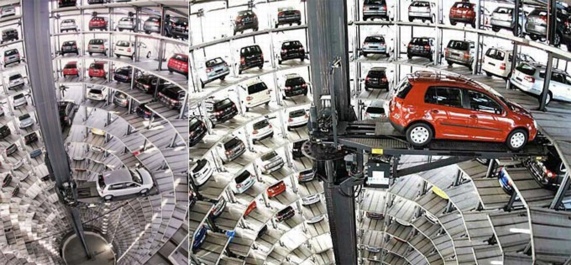


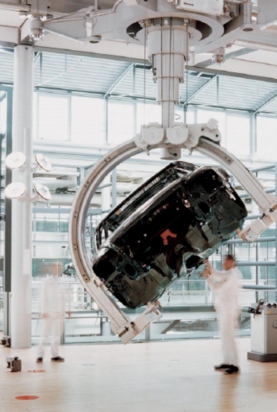
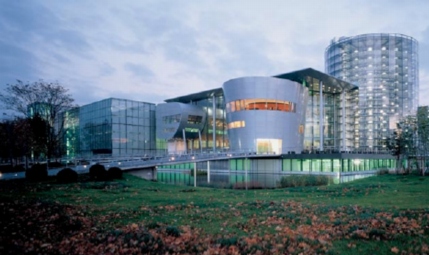
Volkswagen's Transparent Factory (Die Glaserne Manufaktur)
For all you Diecast / Matchbox car collectors, check out this Volkswagen automobile factory in Dresden, Germany. The VW management team and marketing department made the right call when they chose the architectural firm who designed this showcase. The glass display tower where the newly fabricated cars are stored recalls Matchbox hobby display imagery in no uncertain terms. The factory was opened a few years ago and tours are open to the public. Volkswagen's luxury car, the Phaeton, is manufactured at this plant.
With VW's sagging US sales, and high US VW price tags, it's easy to see why VW's overhead might be a bit bloated (as compared to Japanese manufacturers.) I don't know what the Detroit Ford and GM plants look like, but I am guessing they are nothing like the VW plant in Dresden.
But style does count for something (in my book). And the design for this factory is quite impressive on first glance (for those who admire good industrial design).
Although the plant has been open a few years, I thought I'd post the photos here because like my beloved Mac[intosh], I know VW enthusiasts are a (relatively) small group here in the States. (I sure do miss my VW...)
The VW enthusiast forum has posted several high quality photos of the plant and has more information on the plant's design, the manufacturing process, tours, etc. (Be forewarned, there are several photos, so it may take awhile for the VW Forum page to load.) The Dresden plant even has its own website where you can learn more about the factory and see more pics.
Check out both websites. It's a lot of fun -- even if you don't drive a VW.
Thursday, November 16, 2006
Open Source - Freedom to Innovate


Now that the "World Rock, Paper Scissors" competition is settled for the next 12 months, there's no better time than now to use the RPS metaphor in proclaiming that Apple [Computers] cover, smashes and cuts Windows [OS]. My friends and family members know I'm a Macintosh user (23 years and counting), and that I avoid all things Windows-related when possible. With the intention of providing a public service, I am taking this opportunity to tell the handful of tightwad internet surfers who have never heard of Open Office software (www.openoffice.org) that they would do well to sign on to the Open Source movement and ditch the crappy Windows Office Suite of mediocre programs in favor of OpenOffice.
Open Office software has gone through several incarnations the over the years (and has been published under other names). Only more recently has it gained a reputation as a feature packed, stable, comprehensive alternative to Microsoft Office software.
Oh, and did I mention Open Office software is FREE?
Open Office is a suite of Business and Productivity software apps that include: a word processor, presentation, vector drawing, spreadsheet and database programs (replacing MS Word, Excel, Power Point, etc..) No need to worry about compatibility. Open Office can open existing MS Suite documents, and works on various platforms and operating systems, including Windows XP, Mac OS X, GNU/Linux, Sun Solaris. I've created documents in OO and then opened them in MS Word or Excel without problems. The programs are available as a free download. If your internet connection is slow, you can buy a copy on CD or DVD for about $4.95 (plus shipping) from one of the official OO distributors. That beats paying $265-325+ (USD) for a program that often crashes.
For more on the "Open Source movement", check out the GNU / Free Software Foundation (FSF) website.
If I've got to work on a windoze machine (from time to time), at least I don't have to use the equally crummy MS software.
Topic: Technology, Macs
Thursday, November 09, 2006
Green Machine: Tesla Motors Electric Car


Not Your Daddy's Electric Car
From the Green Files: Tesla Motors has rolled out its first 100 all-Electric vehicles and is quickly approaching the 200th. Thank goodness someone with engineering know-how is taking a stab at the archaic petroleum based automotive business model. Treehuggers have known for years that electric cars have been a viable reality in spite of sabotaging efforts from Detroit and petroleum companies worldwide. (Google the 2006 Documentary, "Who Killed the Electric Car?")
Enter California based Tesla Motors' (teslamotors.com) all-electric sports car that goes from 0-to-60 in 4 seconds with a top speed of around 130 MPH. (That 0-60 stat beats a Lamborghini..) It's a 2-seat, open-top, rear drive roadster. It puts those aardvark looking Priuses to shame. The car is designed & engineered in the USA, but built by Lotus Motors (under a contract agreement w/ Tesla) in the UK.
Quoting from the website,
"Because it has no clutch and a very wide, flat torque curve, the acceleration of the Tesla Roadster is much more available to enjoy: just step on the accelerator and go - no matter what speed you are driving, no matter what gear you are in, the acceleration is instantaneous."
Other Tesla highlights include:
- 248 HP; 13,500 RPM
- Zero Foreign oil requirements; Zero Emissions
- Goes 250 miles on a charge
- 2 Speed Transmission; 4-wheel Disk Brakes w/ ABS
- Has a Solar Panel option (for charging), Neat !
- Soft or hardtop option
- Has a port for your iPod (it better at that price !)
- available in 12 colors
- the car can't be hot-wired (so they say..)
- Lots of standard features like Heated Seats & AC, Alloy wheels; Air Bags, Cruise Control, etc.
- Meets Federal DOT requirements for Insurance & Registration
Tesla Motors Service Centers/Showrooms include: San Carlos, CA (corporate headquarters), New York, Chicago, Miami. If anyone sees one around Chicago, email me !
The Downside: These cars go for about $100,000 USD (or about 1-7/8 Hummers). Hey, but remember when the basic calulator back in the 1970s set you back about $250 and only added, subtracted, divided and multiplied?
Time to go get a lottery ticket..
Topic keywords: Green Issues; Design; Electric Cars.
©2006 ShantyWorld.com
Thursday, November 02, 2006
HouseTrucks
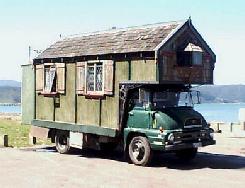

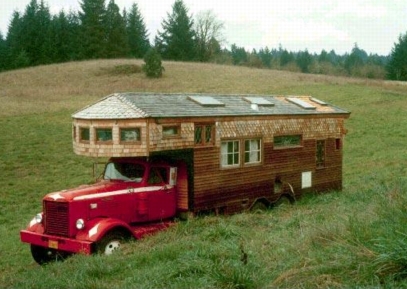
As a grad student, I had a chance to study a fair amount of vernacular & iconic architecture. But I have to admit that this particular nod to the "built-environment" slipped by me. While surfing some of my favorite design websites (and I'll be posting those links here soon too), I came across the site Housetruck.com. It's the brainchild of a guy named Roger D. Beck who has built, lived-in and researched the topic for the last few decades. He's amassed hundreds of photos of these mobile domiciles dating back to the early 1970s and has self-published a book with almost 400 photographs of various mobile bus and truck homes. This gives new meaning to the term "Mobile Home "-- don't it?
I found myself unable to look away, not unlike gawking at a roadside accident. It speaks less to architectural design, imo, than it does to the need for some among us to have the ability to move about freely. It's interesting stuff (from that viewpoint), just the same.
I'm including a link here not so much to encourage like projects, but for the mere spectacle of it all, and as a way to consider how sense of place [home] reconciles with human wanderlust. My Beautiful Shanty, indeed.
There is so much to post.. Hang in there with me people... I've got some interesting stuff coming.
Subscribe to:
Posts (Atom)